DigestFlow Official Website › Blog › How Does DigestFlow Work?
How Does DigestFlow Work? A Row-by-Row Look at the Five Actives
Where it works at all, DigestFlow works through the colon. Caffeine has the most direct evidence, from a coffee study. Chlorogenic acids and green tea catechins are poorly absorbed, so gut bacteria work on them. Raspberry ketone and garcinia have no digestive evidence. The finished capsule has not been trialled.
- The seller says it supports digestive wellness and concerns related to intestinal health. Both are structure and function statements.
- Caffeine has direct colon measurements, but they were taken with coffee, not a capsule.
- Chlorogenic acids and green tea catechins are poorly absorbed, so much of each reaches the colon.
- Raspberry ketone and garcinia have no digestive literature.
- No trial of the finished capsule exists. It is not a probiotic, a fibre, a laxative or an enzyme product.
What does digestive wellness mean on a supplement label?
The seller says DigestFlow is sold to support two things: digestive wellness, and concerns related to intestinal health. These are structure and function statements. They are the ceiling on what anyone may say about the product.
Notice what the phrases leave out. Neither names a condition. Neither names a symptom. Neither gives a timeline. DigestFlow is not a drug, it is not FDA approved, and it is not intended to diagnose, treat, cure or prevent any disease.
So the honest way to ask how it works is to ask what each row could do in the gut, and how strong the proof is. That is the plan for the rest of this page.
How could the 138 mg of caffeine act on the colon?
This is the best-documented route. A research group at Iowa placed a probe with six sensors up the colon of twelve healthy adults. Over ten hours the next day they gave each person black coffee, decaffeinated coffee, water and a 1,000 kcal meal, in random order.
Caffeinated coffee produced colon pressure waves and propagated contractions about as strong as the meal did. The authors put it at 60% stronger than water and 23% stronger than decaffeinated coffee.
Two limits sit on that result. Decaffeinated coffee produced most of the same effect, so something else in coffee does part of the work. And the measurement was of coffee, not of a capsule.
A second trial points the other way. After laparoscopic colon surgery, caffeine at 100 mg and 200 mg did no better than placebo at restoring bowel activity. That was a surgical setting, not a healthy gut, but it shows caffeine is not a universal lever.
The caffeine row also acts quickly, within the hour. If you feel something on day one, it is almost certainly that row, and it will usually feel like alertness, not digestion.
Read the label, then the price
The order page shows today’s price for each pack and the 60-day terms, so the evidence above can sit beside the cost.
See today’s price and guaranteeThis website is a retail desk, the U.S. stocking partner for DigestFlow, not the maker. BuyGoods processes the checkout.
What happens to chlorogenic acids in the gut?
The green coffee bean row is standardised to 50% chlorogenic acids. In one capsule that is about 65 mg. Chlorogenic acids are a family of compounds, and their key property here is poor absorption.
A 2026 review in Nutrition Reviews sets out the route. A large share of what is swallowed passes the small intestine intact and reaches the colon. There, bacterial enzymes break it into caffeic acid and quinic acid, and the bacteria in turn produce short-chain fatty acids and other metabolites.
It is a two-way relationship. The bacteria change the compound, and the compound changes the balance of the bacteria. That describes a change in the gut environment. It does not describe a change in anyone’s symptoms, and no trial has run this amount against a digestive complaint.
The famous weight literature on green coffee is a separate matter. Three pooled trials in 103 people used 500 mg of chlorogenic acids a day, and this capsule holds about 65 mg. The most quoted green coffee weight-loss trial, a 2012 study, was retracted, and this site does not rely on it.
What do green tea catechins do after they are swallowed?
The green tea row is standardised to 45% EGCG, so one capsule gives about 58 mg. Catechins are also poorly absorbed, so a good share reaches the colon.
Here there is a human trial. In a randomised, double-blinded study, 33 people had matcha or a placebo drink for two weeks, and their stool was sequenced before and after. Beta-diversity shifted significantly in the tea group and not in the placebo group. Thirty bacterial genera changed in the tea group against three in the control arm, with Coprococcus up and Fusobacterium down.
That is small, short and used a drink, not a capsule. It is still the most relevant human work behind any row on this panel. It measured what grows in the gut, not how anyone felt.
Which two rows have no digestive evidence?
Raspberry ketone is the aroma compound of red raspberries. A 2021 review summarises a record built on cells and rodents, and says plainly that it is sold at high doses despite a lack of reliable human research. There is no gut-specific human trial at any dose.
Garcinia extract is standardised to 50% HCA, about 65 mg per capsule. Its published trials ran at gram amounts a day and measured body weight, with a mean difference of 0.88 kg that the authors called small and of uncertain relevance. One included trial reported gastrointestinal adverse events twice as often on HCA as on placebo. That is a point against it on a digestive product.
These two rows are on the label, and their amounts are printed. This page has no digestive story to tell about either.
How strong is the evidence for each row?
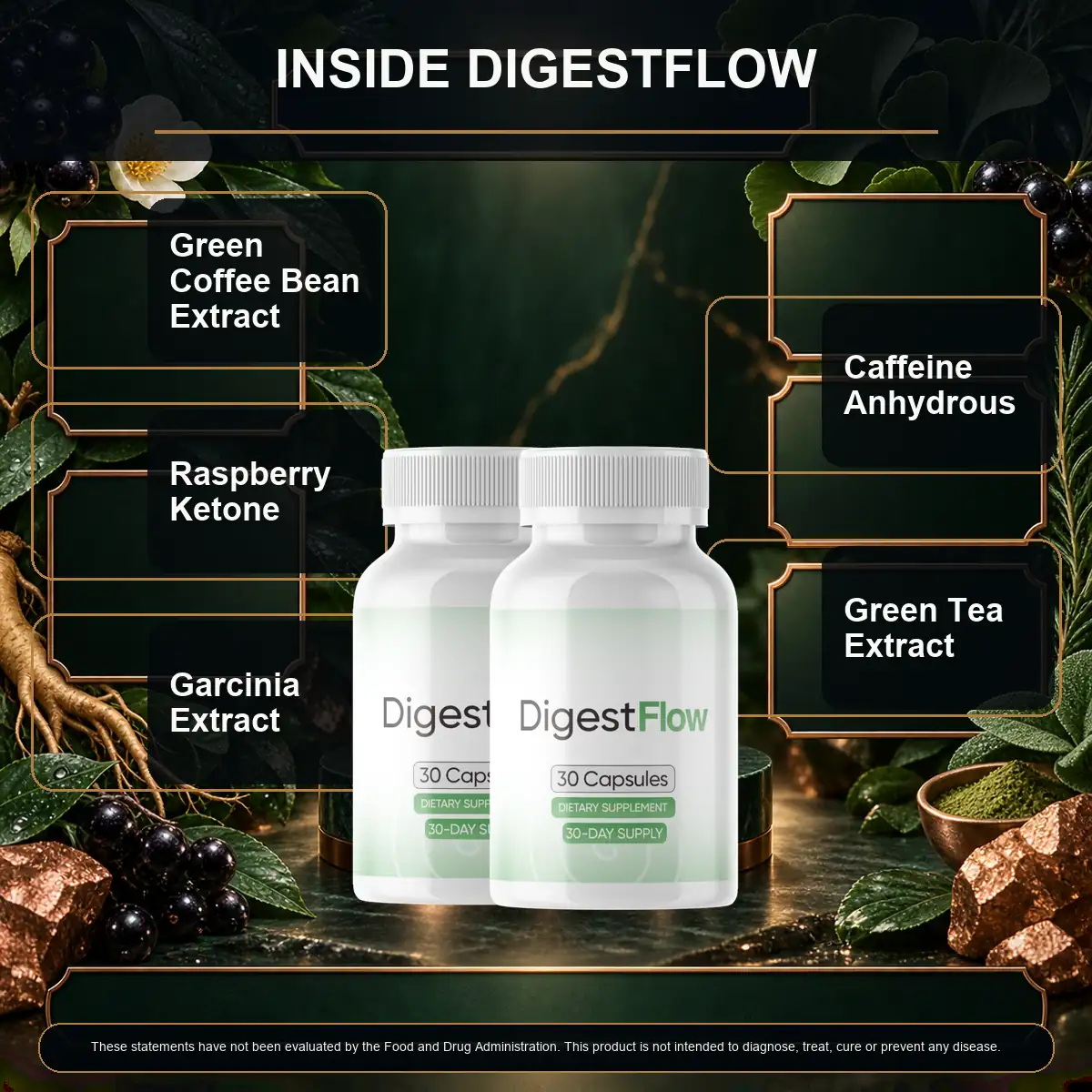
| Row | Possible link to the gut | Strength | How fast |
|---|---|---|---|
| Caffeine anhydrous 138 mg | Colon movement | Direct, but with coffee, and decaf did most of it | Within the hour |
| Green tea extract 130 mg | Catechins reach gut bacteria | One small randomised trial, stool changes only | Two weeks in that trial |
| Green coffee bean extract 130 mg | Chlorogenic acids reach gut bacteria | A described route, no trial at this amount | Days to weeks |
| Garcinia extract 130 mg | None described | None for digestion | No gut timeline exists |
| Raspberry ketone 130 mg | None described | None; cells and rodents only | No gut timeline exists |
The strength column is this site’s reading of the published record for each ingredient, not a measurement of the finished capsule.
Put plainly, the evidence is thinner than the panel looks, and it is concentrated in the row nobody buys a digestive supplement for.
What is DigestFlow not?
- Not a probiotic. There are no bacterial strains and no CFU count.
- Not a fibre. Nothing on the panel bulks or softens stool.
- Not a laxative. There is no senna, cascara, aloe or magnesium.
- Not a digestive enzyme product. There is no amylase, lipase or protease.
- Not a weight product as sold here. Three rows are known from that shelf, but neither the seller nor this site makes a weight claim for the capsule.
It also does not replace finding out why a symptom is happening. New or worsening digestive symptoms, or any with bleeding, unexplained weight loss, fever or pain, call for an assessment, not a supplement.
Where do these facts come from?
The facts above come from the printed label, the distributor’s paperwork and these sources, which this site already cites:
Frequently asked questions
How does DigestFlow work?
Where it works at all, it works through the colon. Caffeine acts on colon movement, while chlorogenic acids and green tea catechins reach gut bacteria. Two rows have no digestive mechanism.
Does DigestFlow work like a probiotic?
No. It adds no bacteria. Two rows feed and shift what is already in the gut, according to the published reviews.
Is caffeine the main ingredient in DigestFlow?
It is the largest row at 138 mg, and it has the most direct evidence, but that evidence is from coffee, not a capsule.
Why are there weight-loss ingredients in a digestive capsule?
Three rows are best known from the weight shelf. Garcinia and raspberry ketone have no gut literature, and this page says so.
Has DigestFlow been tested in a human trial?
No. Nobody has run this combination at these amounts against a digestive outcome.
How long does DigestFlow take to work?
Only the caffeine row acts quickly. The distributor’s reported common wait is 3 to 6 weeks, and the shortest human study behind any row ran two weeks.
Our view
The fair summary is modest. One row has direct colon measurements, though with coffee. Two rows put poorly absorbed compounds where gut bacteria live. Two rows have nothing to say about digestion.
That does not make the capsule useless, and it does not make it proven. It makes it a caffeinated polyphenol capsule with a thin evidence base, sold with a 60-day guarantee.
If a symptom is new, getting worse or comes with bleeding, weight loss, fever or pain, see a doctor first. And because each capsule holds 138 mg of caffeine, ask a doctor if you take a medicine or have a heart, liver or caffeine concern.
Judge it over weeks, not days
The order page shows the current pack prices and the guarantee in full, for when you have decided.
See today’s price and guaranteeThis website is a retail desk, the U.S. stocking partner for DigestFlow, not the maker. BuyGoods processes the checkout.
This page is general information, not medical advice. DigestFlow is a dietary supplement. It is not a drug, it is not FDA approved (no supplement is), and it is not intended to diagnose, treat, cure or prevent any disease. These statements have not been evaluated by the Food and Drug Administration. Ask your own doctor about your own situation.
Last updated .