DigestFlow Official Website › Who It's For
Who It's ForWho Should Take DigestFlow, and Who Should Not
DigestFlow is made for adults who already handle caffeine and want one fixed daily capsule.
Each capsule has 138 mg of caffeine. It suits people willing to judge it over two months, and not anyone avoiding stimulants.
Who this capsule fits, who it does not, and the one question that decides it before any of the others.
The DigestFlow question that comes before all the others
Before ingredients, before price, before the guarantee.
Every capsule contains 138 mg of added caffeine plus a trace from the green tea extract. That is roughly a strong mug of brewed coffee, taken every day, at whatever hour you swallow it.
For most adults that is unremarkable. The FDA cites 400 mg a day as an amount not generally associated with negative effects for healthy adults, and EFSA adds that single doses up to 200 mg raise no safety concern. One capsule is comfortably inside both.
For a minority it decides the question outright, and the seller’s front page gives them no way to know. That is why this desk puts the figure in the hero, in the panel, on this page and in the footer disclaimer.
You avoid caffeine on medical advice. You sleep badly and have been told to cut it. You have an arrhythmia, uncontrolled high blood pressure, or an anxiety disorder that caffeine reliably worsens. You are pregnant or nursing. You are under 18.
Who DigestFlow fits
Four descriptions, and most buyers will recognise themselves in more than one.
The daily coffee drinker with an unremarkable gut
Digestion broadly working, nothing alarming, wanting one fixed habit alongside the fibre, fluid and meal timing that do the real work. The caffeine is already part of their day, so the capsule adds a familiar amount at a known hour.
Somebody who reads panels
This label prints all five amounts and standardises four of them, which makes it checkable in a way much of this category is not. Anyone who wants to know what they are taking can find out, which is what the ingredients page exists to help with.
Anyone avoiding gelatin
The shell is hypromellose, a plant cellulose derivative, and it is the only other ingredient on the label. No filler, no flow agent, no colour and no sweetener are printed.
Somebody prepared to give it two months
Only one row on this panel acts quickly. The rest work, where they work, through the colon over weeks. Two bottles is sixty days and the window is sixty days from purchase, so the arithmetic is straightforward.
Who DigestFlow does not fit
Six situations, each with what to do instead.
| If this is you | Why | What to look at instead |
|---|---|---|
| You avoid caffeine | 138 mg a day, every day, with no caffeine-free version of this product | A caffeine-free digestive product, or the fibre and fluid changes that cost nothing |
| You are pregnant or nursing | The label’s own caution excludes both, and caffeine guidance is lower in pregnancy | A conversation with whoever is looking after you |
| You are under 18 | The label excludes it | Nothing on this website |
| You have a liver condition | Two rows on this panel carry documented liver case reports at higher intakes | The side effects page, then a conversation |
| You want a probiotic or a fibre | Neither is on this panel; there are no strains and no bulking agent | A product whose label names strains and a CFU count, or plain psyllium |
| Your symptoms are new or getting worse | Bleeding, unexplained weight loss, fever or pain need a cause found | NIDDK on irritable bowel syndrome, and an appointment |
Six situations where this product is the wrong answer, with a better one beside each.
A retail desk that cannot name its own product’s poor fits is not worth reading on anything else. Six is not an unusual number; it is what an honest list looks like for a caffeinated capsule.
What to check before the first DigestFlow capsule
Four checks, and the first one settles it for most people it does not suit.
Add up a normal day of caffeine
Coffee, tea, cola, energy drinks and anything pre-workout. Add 138 mg for the capsule and compare the total with 400 mg. If you are already near it, this product pushes you over.
Check your medicine list for caffeine interactions
Several prescriptions change how quickly caffeine is cleared, and some are affected by it in turn. This is a specific question with a specific answer, which is better than a general warning.
Check it against a liver history
Garcinia cambogia and green tea extract both carry documented case reports at higher intakes. The amounts here are far below those, but a liver history is the one circumstance where that margin is worth discussing rather than assuming.
Decide what you are measuring
One symptom, written down daily, starting a week before. Without that, eight weeks from now you will have an impression rather than an answer.
None of those four takes more than a few minutes and the first one rules the product in or out for most people who should not take it. NCCIH’s guidance on using supplements sensibly covers the same ground for the category as a whole.
DigestFlow and reflux: one group worth naming separately
What the largest recent analysis found, and what it does and does not settle.
Anyone whose main complaint is heartburn or regurgitation rather than rhythm is in a different position from the rest of this page, and it is worth ten lines rather than a bullet.
A 2026 systematic review and meta-analysis of forty studies covering 122,074 people found gastro-oesophageal reflux disease more common among coffee drinkers than non-drinkers, 34.9 per cent against 30.7 per cent, with an odds ratio of 1.18. No significant association was found with Barrett’s oesophagus.
Two things follow from that and they pull in opposite directions. The association is real and it is modest, so caffeine is neither harmless nor the dominant factor in anybody’s reflux. And the study measured coffee, which is hot, acidic and volume, where this is a capsule with a glass of water.
The practical answer is the unglamorous one. If caffeine reliably gives you heartburn, your own experience is better evidence than an odds ratio and this capsule is a poor fit. If it does not, this is unlikely to change that.
Reflux that is frequent, waking you at night, or accompanied by difficulty swallowing is worth having assessed rather than managed with a supplement. MedlinePlus is a reasonable place to read about digestive symptoms in plain language before that conversation.
DigestFlow and medication: the two conversations worth having
Two specific issues rather than a general warning.
Caffeine and how quickly you clear it
Caffeine is cleared largely by one liver enzyme, and several medicines slow that down, which turns 138 mg into an effectively larger dose. Others work the other way. This is a question with a specific answer for your own list, which is worth more than a general caution. The systematic review behind the 400 mg figure notes that sensitivity varies widely between individuals for exactly this kind of reason.
Anything with a liver warning already on it
Two rows on this panel, garcinia and green tea extract, have documented liver case reports at higher intakes. Somebody already taking a medicine that carries a liver caution is the one person for whom the margin here is worth discussing rather than assuming. The side effects page sets out both files with the amounts involved.
The label’s own caution covers this in one sentence: “Do not exceed recommended dose. Not for use by individuals under the age of 18 or pregnant or nursing mothers. Consult a physician prior to use especially if you are taking a medication or have a medical condition.” Quoting it once and naming the two actual issues is more use than repeating it in five places.
Who publishes this DigestFlow website?
- Muftah M, McCarty TR, Hartnett D, et al. Association of Coffee Intake With Risk of Gastroesophageal Reflux Disease and Complications: A Systematic Review and Meta-Analysis. Clin Transl Gastroenterol. 2026;17(4):e00996. PMID 41677121. https://pubmed.ncbi.nlm.nih.gov/41677121/
- Doepker C, Franke K, Myers E, et al. Key Findings and Implications of a Recent Systematic Review of the Potential Adverse Effects of Caffeine Consumption in Healthy Adults, Pregnant Women, Adolescents, and Children. Nutrients. 2018;10(10):1536. PMID 30340340. https://pubmed.ncbi.nlm.nih.gov/30340340/
- Spilling the Beans: How Much Caffeine is Too Much? U.S. Food and Drug Administration, consumer update. https://www.fda.gov/consumers/consumer-updates/spilling-beans-how-much-caffeine-too-much
- EFSA Panel on Dietetic Products, Nutrition and Allergies. Scientific Opinion on the safety of caffeine. EFSA Journal. 2015;13(5):4102. https://www.efsa.europa.eu/en/efsajournal/pub/4102
- Irritable Bowel Syndrome (IBS). National Institute of Diabetes and Digestive and Kidney Diseases, National Institutes of Health. https://www.niddk.nih.gov/health-information/digestive-diseases/irritable-bowel-syndrome
- Constipation. MedlinePlus, U.S. National Library of Medicine. https://medlineplus.gov/constipation.html
- Using Dietary Supplements Wisely. National Center for Complementary and Integrative Health, National Institutes of Health. https://www.nccih.nih.gov/health/using-dietary-supplements-wisely
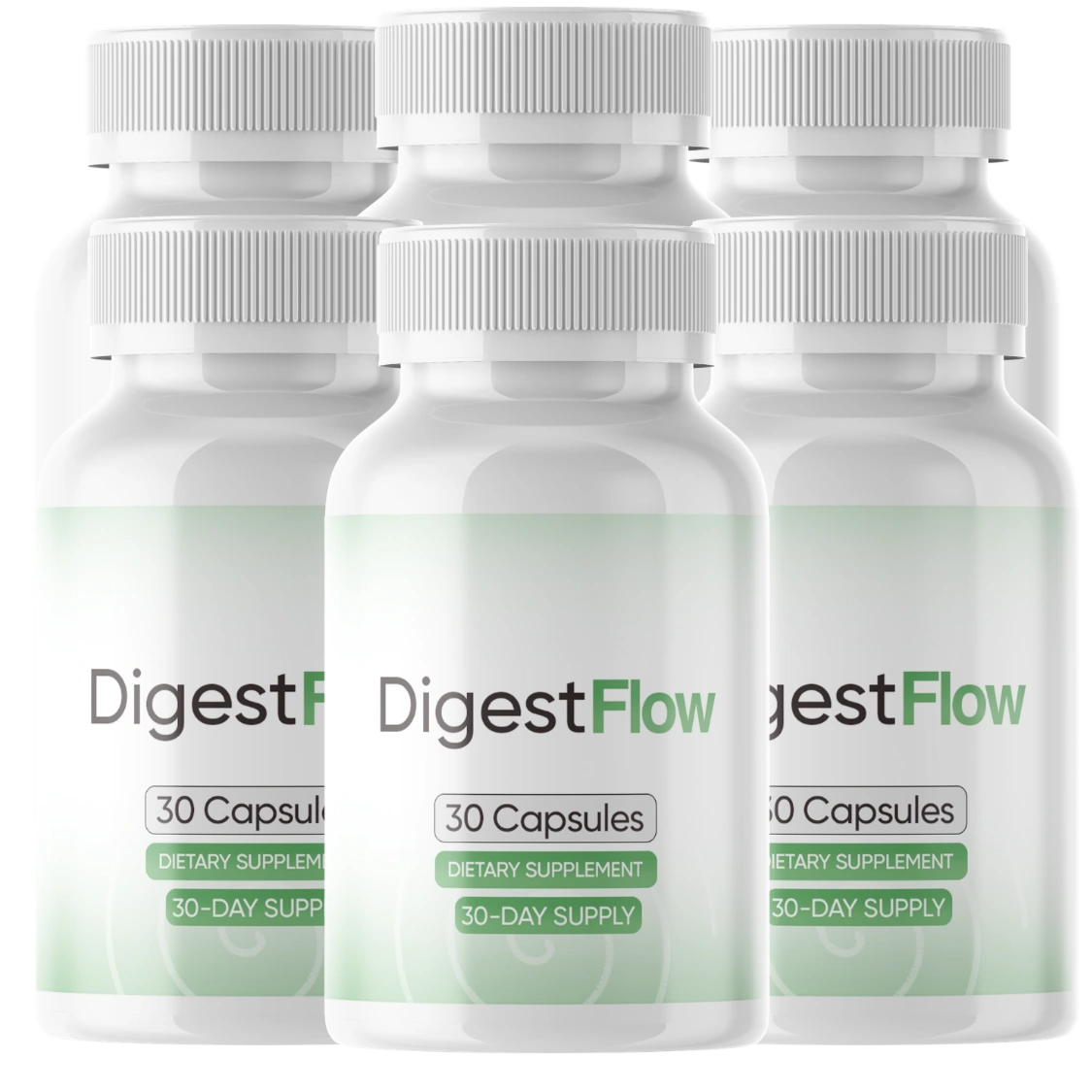
Order DigestFlow if it is a fit
One capsule a day with 138 mg of caffeine in it, and 60 days from the date of purchase to change your mind.
Two bottles $158 · six bottles $294 · 60 days from the date of purchase
Order DigestFlow On The Official WebsiteOne capsule a day · 30 per bottle · lot DIG-26/DI-5237