DigestFlow Official Website › Ingredients
IngredientsDigestFlow Ingredients and the Dose of Each One
Each DigestFlow capsule holds five named actives, and the label prints a milligram amount for every one.
The standardised extracts give about 65 mg of chlorogenic acids, 65 mg of hydroxycitric acid and 58 mg of EGCG, next to 130 mg of raspberry ketone and 138 mg of caffeine.
To see how these fit together, read how DigestFlow works.
What is in the capsule, what each percentage does to the number beside it, and what the published work on each row actually found.
The five rows on the DigestFlow panel, at a glance
The printed weight first, then what each one comes to once its percentage is applied.
| Row | What the label prints | What that works out to |
|---|---|---|
| Green coffee bean extract | 130 mg at 50% chlorogenic acids | about 65 mg of chlorogenic acids |
| Raspberry ketone | 130 mg, no standardisation printed | 130 mg of the compound itself |
| Garcinia extract | 130 mg at 50% HCA | about 65 mg of hydroxycitric acid |
| Caffeine anhydrous | 138 mg, unstandardised | 138 mg of caffeine, plus a little more from the green tea row |
| Green tea extract | 130 mg at 45% EGCG | about 58 mg of EGCG and roughly 98 mg of total polyphenols |
Arithmetic on the label’s own standardisation percentages. Nothing in the right-hand column is an estimate of a figure the label left open.
Two rows carry no percentage at all: caffeine anhydrous is caffeine, and raspberry ketone is sold as the isolated compound. The other three are plant extracts, where the weight of the extract and the weight of the compound it is standardised to are very different numbers. That distinction is the most useful thing to understand about a supplement panel.
What each DigestFlow ingredient is, and what the research found
Five cards, in panel order, each with the published work rather than a description.
Green Coffee Bean Extract
Coffea robusta, seed, 50% chlorogenic acids130 mgCoffee beans that were never roasted. Roasting is what destroys most of a bean’s chlorogenic acids, which is why the unroasted extract is the one sold for them, and this row is standardised so that half its weight is that compound family.
Its claim on a digestive label rests on poor absorption rather than good. A 2026 review in Nutrition Reviews describes a large proportion arriving in the colon intact, where resident bacteria degrade it into caffeic and quinic acids and short-chain fatty acids.
Its more famous literature is about body weight, and that is where the amount here falls short. Three pooled randomised trials in 103 people tested 500 mg of chlorogenic acids a day. This row supplies about 65 mg.
Raspberry Ketone
4-(4-hydroxyphenyl)butan-2-one130 mgThe aromatic compound responsible for the smell of red raspberries, also present in kiwifruit, peaches and apples, and produced at scale for flavour and fragrance long before anyone sold it in a capsule.
This is the weakest row on the panel. The 2021 review of the compound summarises a record built on cells and rodents, with PPAR-alpha activation as the proposed mechanism, and states in its own abstract that it is marketed at very high doses in spite of a lack of reliable human research.
There is no gut-specific human trial to summarise, at any dose. A reader deciding on this product should treat this row as costing nothing and proving nothing.
Garcinia Extract
Garcinia cambogia, fruit, 50% HCA130 mgDried rind of the Malabar tamarind, a souring agent in South Asian cooking for centuries, standardised here so that half its weight is hydroxycitric acid. That gives about 65 mg of HCA per capsule.
The pooled randomised trials ran at gram quantities of HCA a day and produced a mean difference against placebo of 0.88 kg, which the authors described as small and of uncertain clinical relevance. One of the included trials reported gastrointestinal adverse events twice as often on HCA as on placebo, which is worth knowing on a product sold for digestive comfort.
It also brings the panel’s one real safety file with it, set out in full on side effects. The short version is that the case reports involve gram-scale daily intakes rather than 65 mg.
Caffeine Anhydrous
dried caffeine138 mgCaffeine with the water removed, which is the form used wherever a precise amount is wanted. At 138 mg this is the largest row on the panel and roughly what a strong mug of brewed coffee delivers.
It is also the row with the most direct evidence about the organ this product is sold for. Ambulatory manometry in twelve healthy volunteers found caffeinated coffee produced colonic motor activity of about the same magnitude as a 1,000 kcal meal, 60 per cent stronger than water and 23 per cent stronger than decaffeinated coffee.
That last figure cuts both ways: decaffeinated coffee produced most of the same effect, so caffeine is one contributor rather than the whole explanation. A randomised trial of pure caffeine after laparoscopic colectomy found 100 mg and 200 mg doses no better than placebo at restoring bowel activity.
Green Tea Extract
Camellia sinensis, leaf, 98% polyphenols, 45% EGCG130 mgThe most heavily standardised row on the label: 98 per cent polyphenols, 75 per cent catechins, 45 per cent epigallocatechin gallate and under 3 per cent caffeine. That works out at roughly 58 mg of EGCG and about 98 mg of total polyphenols per capsule.
Catechins are poorly absorbed too, so a substantial fraction reaches the colon. A randomised, double-blinded trial gave thirty-three people matcha or a placebo drink for two weeks and sequenced their stool: beta-diversity shifted significantly in the tea group and not in the placebo group, with thirty genera changing against three.
The 58 mg figure also matters for safety, and there it is reassuring. The United States Pharmacopeia review of green tea extract case reports found the intakes involved began around 140 mg of EGCG a day. NCCIH sets out the same distinction between drinking tea and taking a concentrated extract.
What else is in a DigestFlow capsule
One line, one item, and a short list of things that are not there.
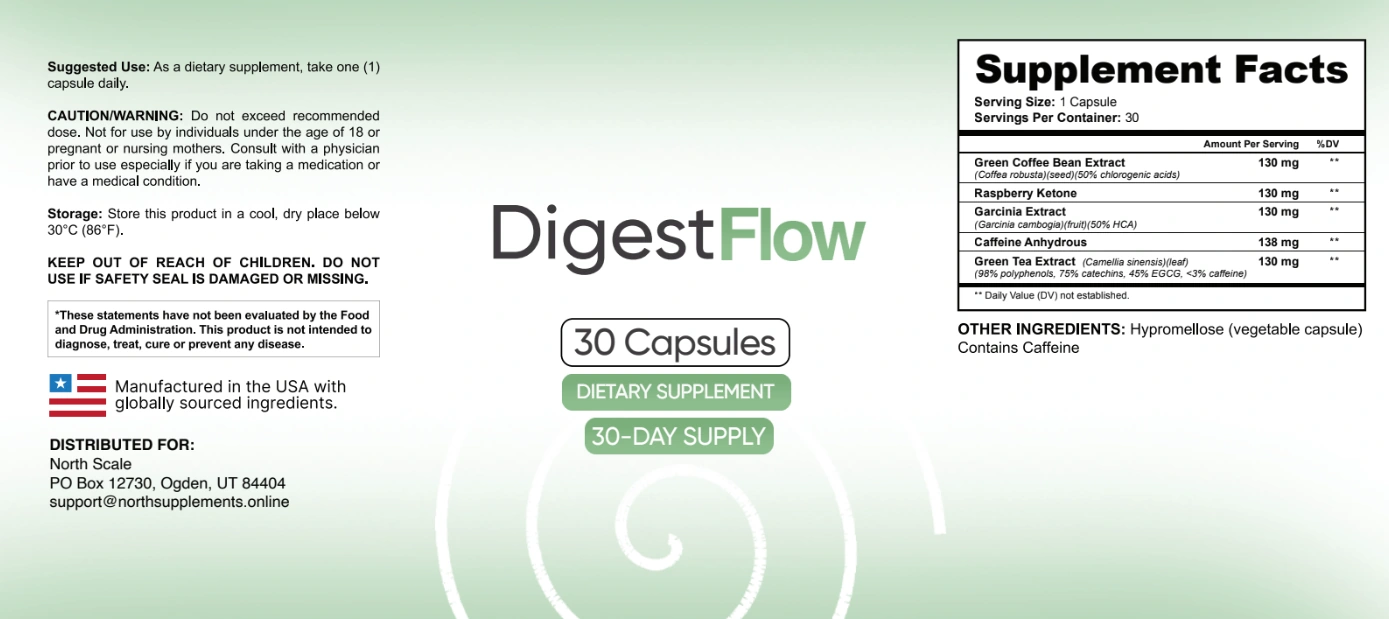
Beneath the five actives the label prints one other-ingredients line, and it is one item long: hypromellose (vegetable capsule).
Hypromellose is hydroxypropyl methylcellulose, made from plant cellulose. It is the standard alternative to a gelatin shell and it means this capsule is not animal-derived. For anyone who has had to put a gut product back on the shelf over a gelatin line, that is a real answer rather than a marketing one.
What is absent from that line is as informative as what is on it. No filler, no flow agent such as magnesium stearate, no colour, no anti-caking agent and no sweetener. On a five-ingredient capsule that is credible; on a twenty-ingredient one it usually would not be.
Below the panel the label adds a line of its own: “Contains Caffeine”. That is the sentence most worth reading before the first capsule, and it is treated at length on side effects.
Reading the DigestFlow panel against the published amounts
Five printed amounts against the amounts the studies behind them used.
This is the blunt section and it is the only one on this page. Everything above is what the capsule contains; this is how those amounts sit against the amounts the published work used.
The pattern is consistent and it is worth naming once. Where a row is on this panel for a gut effect, the amount is in the right neighbourhood, because those mechanisms depend on the compound reaching the colon rather than on crossing a dose threshold. Where a row is on this panel for the reason it became famous, the amount is a small fraction of what the trials used.
Green coffee and garcinia are the two clearest examples. Both carry a real standardisation and a real literature. Both deliver about 65 mg where the studies ran at 500 mg and at gram quantities respectively.
138 mg of caffeine a day, at whatever hour you take the capsule. Add it to everything else you drink and judge the total, not this capsule on its own.
DigestFlow ingredient questions
Is there a proprietary blend?
No. Each of the five actives has its own line and its own milligram figure, and there is no combined total standing in for them. That is the main thing this label does better than much of its category.
Which row is doing the most work?
On the evidence, the caffeine row, because it has the most direct measurement behind it. On weight, also the caffeine row, at 138 mg against 130 mg for each of the others.
Are there probiotics or fibre in it?
Neither. There are no bacterial strains, no CFU count and no fibre anywhere on this panel. It is five plant-derived actives in a plant-derived shell.
Why is a weight-loss ingredient in a digestive capsule?
Three of these five rows are best known from the weight shelf. Three of them, counting differently, also have published work about the gut specifically, which is what how it works is built from. Garcinia and raspberry ketone are the two that do not, and this page says so.
Who publishes this DigestFlow website?
- Kong H, Han J, Meng X, Wang X, Zhang XA. Chlorogenic Acid-Gut Microbiota Interactions: New Insights for Alleviating Chronic Diseases and Health Disorders. Nutr Rev. 2026;84(10):2147-2173. PMID 41259210. https://pubmed.ncbi.nlm.nih.gov/41259210/
- Kanchanasurakit S, Saokaew S, Phisalprapa P, Duangjai A. Chlorogenic acid in green bean coffee on body weight: a systematic review and meta-analysis of randomized controlled trials. Syst Rev. 2023;12(1):163. PMID 37710316. https://pubmed.ncbi.nlm.nih.gov/37710316/
- Rao S, Kurakula M, Mamidipalli N, Tiyyagura P, Patel B, Manne R. Pharmacological Exploration of Phenolic Compound: Raspberry Ketone-Update 2020. Plants (Basel). 2021;10(7):1323. PMID 34209554. https://pubmed.ncbi.nlm.nih.gov/34209554/
- Onakpoya I, Hung SK, Perry R, Wider B, Ernst E. The Use of Garcinia Extract (Hydroxycitric Acid) as a Weight loss Supplement: A Systematic Review and Meta-Analysis of Randomised Clinical Trials. J Obes. 2011;2011:509038. PMID 21197150. https://pubmed.ncbi.nlm.nih.gov/21197150/
- Rao SS, Welcher K, Zimmerman B, Stumbo P. Is coffee a colonic stimulant? Eur J Gastroenterol Hepatol. 1998;10(2):113-8. PMID 9581985. https://pubmed.ncbi.nlm.nih.gov/9581985/
- Abbassi F, Muller SA, Steffen T, et al. Caffeine for intestinal transit after laparoscopic colectomy: randomized clinical trial (CaCo trial). Br J Surg. 2022;109(12):1216-1223. PMID 35909263. https://pubmed.ncbi.nlm.nih.gov/35909263/
- Oketch-Rabah HA, Roe AL, Rider CV, et al. United States Pharmacopeia (USP) comprehensive review of the hepatotoxicity of green tea extracts. Toxicol Rep. 2020;7:386-402. PMID 32140423. https://pubmed.ncbi.nlm.nih.gov/32140423/
- Morishima S, Kawada Y, Fukushima Y, Takagi T, Naito Y, Inoue R. A randomized, double-blinded study evaluating effect of matcha green tea on human fecal microbiota. J Clin Biochem Nutr. 2023;72(2):165-170. PMID 36936880. https://pubmed.ncbi.nlm.nih.gov/36936880/
- Green Tea: Usefulness and Safety. National Center for Complementary and Integrative Health, National Institutes of Health. https://www.nccih.nih.gov/health/green-tea
Order DigestFlow from the official website
Five actives, every amount printed, one capsule a day and 60 days from the date of purchase.
Two bottles $158 · six bottles $294 · 60 days from the date of purchase
Order DigestFlow On The Official WebsiteOne capsule a day · 30 per bottle · lot DIG-26/DI-5237