DigestFlow Official Website › Blog › Raspberry Ketone And The Missing Evidence
Raspberry Ketone, And The Famous Ingredients With Nothing Behind Them
Three of the five rows on the DigestFlow panel arrived on supplement labels through publicity rather than through evidence. One of them rests on a trial that was later retracted, and one has, on its own reviewers’ account, no reliable human research at all.
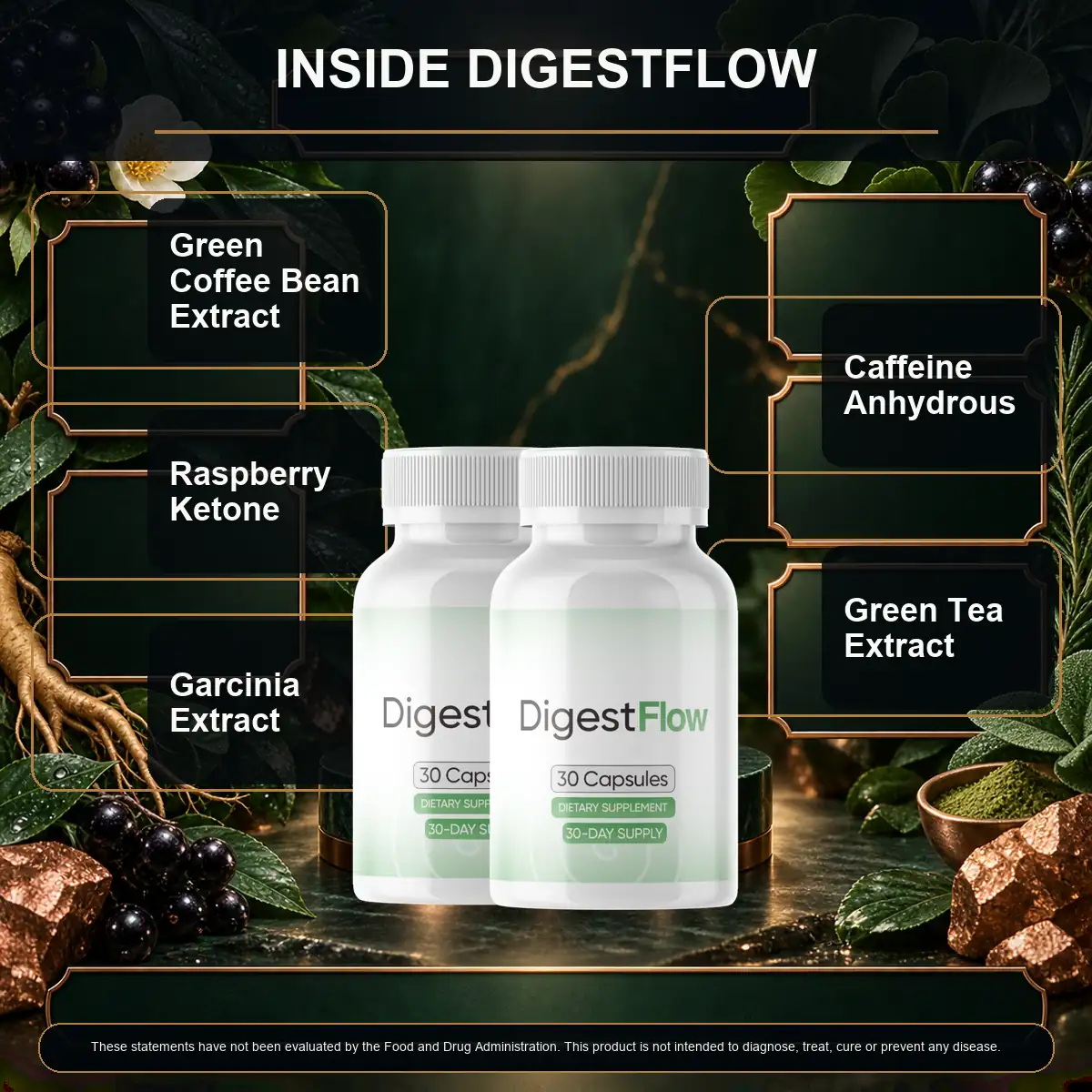
- Raspberry ketone is the aromatic compound that gives red raspberries their smell, produced at industrial scale for flavour and fragrance long before it was sold in capsules.
- Its 2021 review describes a record built on cells and rodents and states plainly that it is marketed at very high doses in spite of a lack of reliable human research.
- There is no gut-specific human study of it at any amount.
- Green coffee bean extract, another row on this panel, became famous through a 2012 trial that was later retracted.
- Both amounts are printed, which is what makes this article possible and is the one thing this label does better than most.
What raspberry ketone actually is
4-(4-hydroxyphenyl)butan-2-one is the compound responsible for the characteristic smell of red raspberries. It also occurs naturally in kiwifruit, peaches and apples, in very small quantities, and it has been produced synthetically for decades as a flavour and fragrance ingredient.
The amount in the fruit is the part that surprises people. Extracting a supplement dose from raspberries would take an implausible quantity of fruit, which is why essentially all raspberry ketone sold in capsules is made rather than harvested. Nothing about that is sinister; it is simply what the word natural does and does not tell you on a label.
At 130 mg it is the second-largest row on this panel and the only one with no standardisation percentage, because there is nothing to standardise: it is the compound itself rather than a plant extract containing it.
How it became a supplement ingredient
The proposed mechanism is PPAR-alpha activation, a pathway involved in fatty acid metabolism, observed in rodent work. The 2021 review of the compound sets out the range of properties attributed to it in that literature: hepatic, cardiac and gastric protection, anti-hyperlipidaemic and anti-obesity effects, depigmentation, and sexual maturation, all in cells and rodents.
What turned it into a shelf product was publicity rather than any of that. Around 2012 it received a great deal of television promotion in the United States, and the supplement market responded the way it responds to publicity, with a large number of products carrying a large number of milligrams.
That sequence is the important part and it recurs. An ingredient becomes famous, labels adopt it, and the evidence base is asked to catch up afterwards. Sometimes it does.
What the published record contains
The 2021 review is not a hostile source. It is a pharmacological exploration written to set out what has been found and to encourage further work, and its own conclusion is the clearest statement available.
It describes rodent studies as having demonstrated efficacious effects while noting that the mechanism remains largely unknown. And then, in its own abstract, it states that in spite of a lack of reliable human research, raspberry ketone is marketed as a health supplement at very high doses.
That is a review of an ingredient saying, in the section most likely to be read, that the human evidence is not there. There is no gut-specific human work at all, at any amount, which is the relevant absence for a product sold for digestive wellness.
| Question | Raspberry ketone on this label | What a good answer looks like |
|---|---|---|
| Is the amount printed? | Yes, 130 mg | A figure, not a blend total |
| Is it standardised? | Not applicable; it is the isolated compound | A percentage, or a statement that none is needed |
| Is there a human trial of it alone? | No | At least one randomised controlled trial of the single ingredient |
| Is there a trial at this amount? | No | A trial using a comparable daily amount |
| Is there a gut-specific study? | No | Any human study measuring a digestive outcome |
| Is the mechanism described in humans? | No, PPAR-alpha activation in rodents | A described pathway observed in people |
Six questions applied to one row. Five answers are no, which is an unusually clean result and is the reason this article exists.
DigestFlow prints every amount, including this one
130 mg of raspberry ketone, on the panel, beside four other actives with their own figures. A label that publishes an amount is a label whose claims can be checked.
Two bottles $158 · six bottles $294 · 60 days from the date of purchase
Order DigestFlow On The Official WebsiteOne capsule a day · 30 per bottle · lot DIG-26/DI-5237
The retraction most people have never heard about
Green coffee bean extract sits one row above raspberry ketone on this panel, and its public reputation rests on a study that no longer exists in the literature.
A 2012 randomised crossover trial reported striking weight loss in overweight subjects taking green coffee bean extract. It was promoted heavily, it was quoted everywhere, and it is the source of the headline figures that still circulate about the ingredient. It was subsequently retracted, and its PubMed record carries the publication type Retracted Publication.
This website does not cite it, which is worth stating explicitly rather than leaving as an absence somebody has to notice. Any summary of green coffee bean extract leaning on a dramatic weight-loss figure is leaning on a retracted paper, and that includes a great deal of what is written about the ingredient online.
What remains is more modest. A 2023 systematic review and meta-analysis pooled three randomised controlled trials in 103 people using at least 500 mg of chlorogenic acids a day, and found a weighted mean difference of 1.30 kg with no heterogeneity and no detected publication bias. Three trials and 103 people is a small evidence base, and 500 mg a day is roughly eight times what this panel delivers.
Because a retraction sweep that finds nothing is indistinguishable from a retraction sweep that was never run. This one found something, on an ingredient this website sells, and printing it is the only way a reader can tell the difference. The method is described on the about page.
The pattern the three rows share
| Ingredient | What made it famous | What the human record shows |
|---|---|---|
| Raspberry ketone | Television promotion around 2012 and a rodent study on fat metabolism | No reliable human research. The 2021 review says so in its own abstract |
| Green coffee bean extract | A widely publicised 2012 trial reporting large weight loss | That trial was RETRACTED. The pooled evidence that remains runs at 500 mg of chlorogenic acids a day for a mean 1.30 kg difference |
| Garcinia cambogia | A long-running weight-loss reputation | Pooled trials show a mean 0.88 kg difference of uncertain clinical relevance, at gram quantities |
Three ingredients on this panel that arrived on supplement labels through publicity rather than through evidence. The middle row is the one most people have never been told about.
Read those three together and a shape emerges that is not specific to this product. Each of them reached supplement labels through attention rather than through accumulated evidence, and in each case the evidence that arrived afterwards was thinner than the reputation.
Garcinia’s pooled result is a mean difference of 0.88 kg that its own authors called of uncertain clinical relevance. Green coffee’s headline trial was retracted and what replaced it is three small studies at eight times this dose. Raspberry ketone has no human record at all.
None of that is an argument that these ingredients are harmful, and two of the three have no safety file worth speaking of. It is an argument that fame and evidence are different quantities, and that a label containing famous ingredients is not the same thing as a label containing evidenced ones.
Six questions to ask of any famous ingredient
- Is the amount printed, or hidden in a blend total? A blend total means nothing can be checked.
- Is there a human trial of this ingredient alone, rather than in a combination?
- Was that trial at a comparable amount to the one on the label?
- Does the trial measure the outcome the product is sold for, or a different one?
- Does the ingredient’s most-quoted study still exist, or has it been retracted?
- What does a neutral source such as NCCIH say about it, rather than a seller?
Applied to raspberry ketone on this label, the answers are yes, no, not applicable, no, not applicable and very little. Applied to the green tea row on the same label they come out considerably better, which is the point of asking per row rather than per product. NCCIH’s overview of dietary and herbal supplements and its guidance on using them sensibly are reasonable places to start on any ingredient.
Why a printed amount changes the argument
It would be easy to read this article as an argument against this product, and that is not quite what it is.
Every criticism above is possible because the label prints its numbers. A panel carrying a combined blend total for five ingredients would make all of it unanswerable: no amount to compare against a trial, no percentage to convert, no way to establish that a row is eight times below its studied dose.
A label that publishes its amounts has chosen to be falsifiable. A label that hides them has chosen not to be. That choice is the most informative single thing on most supplement packs, and it is why the checklist on this site scores it first.
The correct conclusion is narrower and more useful than a verdict on the product: two rows on this panel are doing nothing for the purpose it is sold for, their amounts are printed, and you can see that for yourself.
What this desk concludes
Raspberry ketone at 130 mg is the weakest item on this panel and this desk has no case to make for it. It is on the label because of what it was famous for a decade ago, and its own reviewers say the human research is absent.
Green coffee bean extract is a different proposition, because it has a gut literature separate from its weight literature, and the polyphenol article sets out why that one is defensible on a digestive label at an amount that would not be defensible on a weight one.
The panel would be stronger with raspberry ketone removed. Saying so on the website that sells it is uncomfortable and is the only position that leaves the rest of this site worth reading.
References
- Rao S, Kurakula M, Mamidipalli N, Tiyyagura P, Patel B, Manne R. Pharmacological Exploration of Phenolic Compound: Raspberry Ketone-Update 2020. Plants (Basel). 2021;10(7):1323. PMID 34209554. https://pubmed.ncbi.nlm.nih.gov/34209554/
- Kanchanasurakit S, Saokaew S, Phisalprapa P, Duangjai A. Chlorogenic acid in green bean coffee on body weight: a systematic review and meta-analysis of randomized controlled trials. Syst Rev. 2023;12(1):163. PMID 37710316. https://pubmed.ncbi.nlm.nih.gov/37710316/
- Onakpoya I, Hung SK, Perry R, Wider B, Ernst E. The Use of Garcinia Extract (Hydroxycitric Acid) as a Weight loss Supplement: A Systematic Review and Meta-Analysis of Randomised Clinical Trials. J Obes. 2011;2011:509038. PMID 21197150. https://pubmed.ncbi.nlm.nih.gov/21197150/
- Dietary and Herbal Supplements. National Center for Complementary and Integrative Health, National Institutes of Health. https://www.nccih.nih.gov/health/dietary-and-herbal-supplements
- Using Dietary Supplements Wisely. National Center for Complementary and Integrative Health, National Institutes of Health. https://www.nccih.nih.gov/health/using-dietary-supplements-wisely