DigestFlow Official Website › Blog › What Reaches Your Colon
What Actually Reaches Your Colon: Polyphenols, Absorption And Gut Bacteria
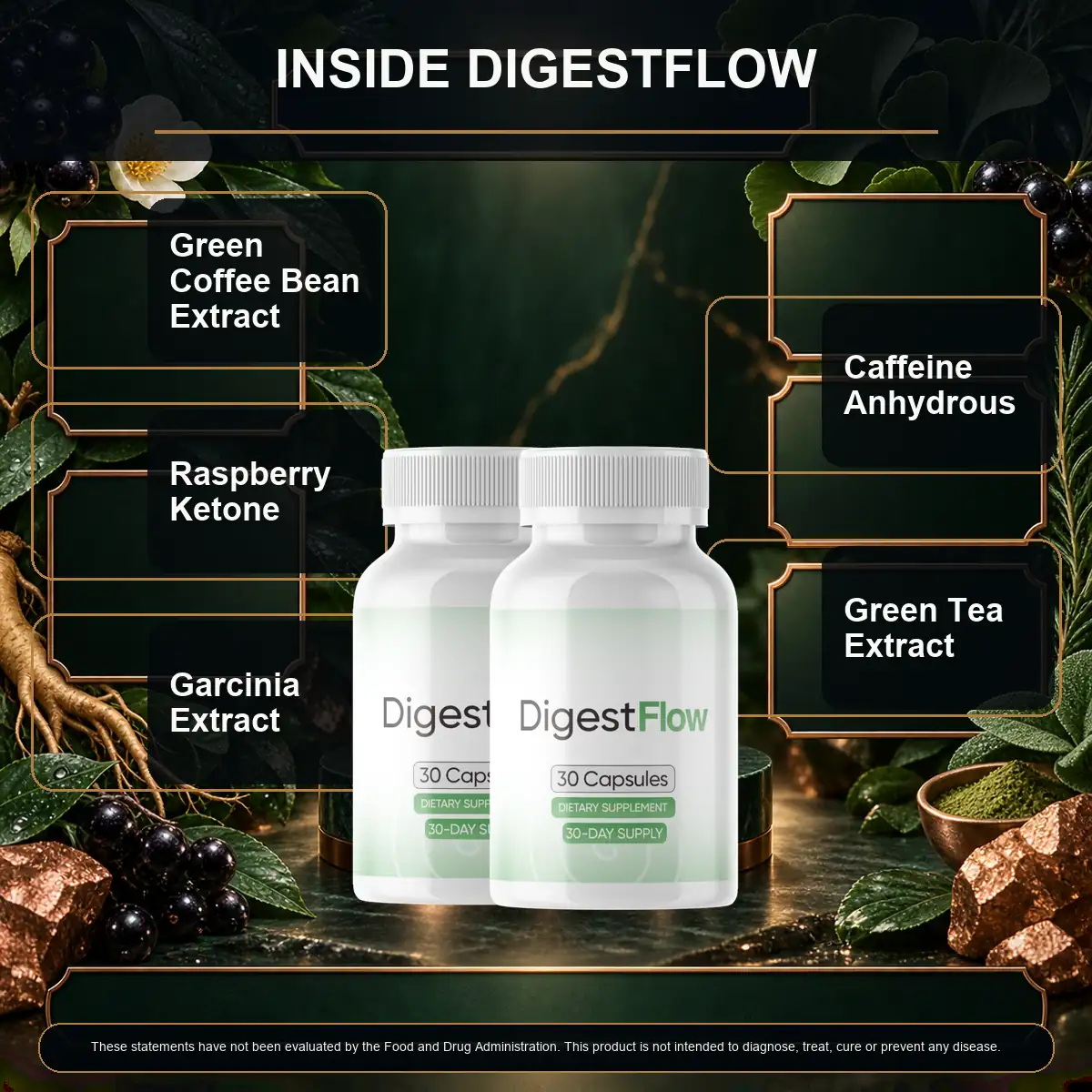
Supplement marketing treats absorption as a virtue and spends its copy arguing that more of a compound reaches the bloodstream. For a gut ingredient that logic runs exactly backwards, and understanding why explains two of the five rows on the DigestFlow panel.
- A compound absorbed in the small intestine has left the digestive tract before it reaches the part of it with a microbial population.
- Chlorogenic acids and catechins are both poorly absorbed, so a large share arrives in the colon intact.
- There, bacteria degrade them into smaller phenolic acids and short-chain fatty acids, and the balance of what grows shifts.
- That is a change in the gut environment. It is not a measured improvement in anybody's symptoms, and no polyphenol product in this category has that.
- It also means these rows do not need a gram to be doing something, although nobody has measured what 65 mg or 58 mg does on its own.
The rule that runs backwards
Almost every claim made about absorption in supplement marketing is a claim that more of something gets into the blood. Liposomal this, enhanced bioavailability that, black pepper extract added to raise the fraction absorbed. For most ingredients that is the right direction: a vitamin has to reach the tissue that uses it.
A gut ingredient is the exception and the inversion is complete. The colon is the part of the digestive tract with a substantial microbial population, and it is a long way downstream of where absorption mostly happens. A compound taken up efficiently in the small intestine never gets there.
So for two of the five rows on this panel, poor bioavailability is not a limitation that has been worked around. It is the reason they are on the label at all.
| Compound class | Absorbed in the small intestine? | What that means for the gut |
|---|---|---|
| Most vitamins and minerals | Largely yes | They leave the digestive tract early and act elsewhere |
| Chlorogenic acids | Largely no | A large proportion arrives in the colon intact and is worked on by bacteria |
| Catechins, including EGCG | Poorly, and variably | A substantial fraction reaches the colon, where the same thing happens |
| Caffeine | Yes, almost completely | It acts systemically; its colonic effect is not about reaching the colon undigested |
| Bulk-forming fibre | Not at all, by design | It holds water and changes stool form mechanically rather than chemically |
Five classes, of which the middle two are the ones this article is about. Poor absorption is a disadvantage for a vitamin and the entire point of a gut polyphenol.
Where chlorogenic acid ends up
Chlorogenic acid is not one molecule but a family of esters formed between caffeic acid and quinic acid, found in coffee, fruits and vegetables. Roasting destroys much of it, which is why the extract sold for it is made from unroasted beans.
A 2026 review in Nutrition Reviews sets out the sequence in detail. During digestion a large proportion of dietary chlorogenic acid is not absorbed and reaches the colon, where it interacts with the resident microflora. There it is degraded into colonic metabolites including caffeic and quinic acids, which are then absorbed and circulate.
The review describes the compound increasing microbial diversity and the proportion of beneficial organisms, reducing harmful ones, and changing the metabolites produced, including short-chain fatty acids, indole compounds and hydroxycinnamic acids.
And the same is true of coffee more generally
A review of coffee’s bioactive compounds lists microbiota modulation among the effects attributed to its polysaccharides, melanoidins and chlorogenic acids, alongside anti-inflammatory and antidiabetic actions credited to the same family.
That is worth holding beside the manometry finding described in the caffeine article: decaffeinated coffee produced most of the colonic effect measured there, and the chlorogenic acids that survive decaffeination are among the plausible reasons why.
The relationship is two-way
The part of this that is genuinely interesting, and the part most labels flatten into nothing, is that the traffic runs both ways.
The bacteria change the compound. Enzymes they produce cleave the ester bond, releasing caffeic and quinic acids, and further metabolism produces smaller phenolics that the host then absorbs. Some of what circulates in somebody who drinks coffee was made by their gut bacteria rather than by the coffee.
And the compound changes the bacteria. The same review describes shifts in composition and diversity following intake, with downstream effects on gut barrier function and on metabolite production.
Neither half of that is a claim that a symptom improves. It is a description of an ecosystem being fed something it can work on, which is a smaller and more defensible claim than most polyphenol marketing makes.
DigestFlow publishes both polyphenol figures
Green coffee bean extract standardised to 50 per cent chlorogenic acids and green tea extract to 45 per cent EGCG, with the printed weights on the panel so the compound weights can be worked out.
Two bottles $158 · six bottles $294 · 60 days from the date of purchase
Order DigestFlow On The Official WebsiteOne capsule a day · 30 per bottle · lot DIG-26/DI-5237
The same story for green tea catechins
Green tea extract on this panel is standardised to 98 per cent polyphenols, 75 per cent catechins and 45 per cent EGCG, which at 130 mg works out at roughly 58 mg of EGCG and about 98 mg of total polyphenols.
Catechins behave much like chlorogenic acids in the gut: absorption is poor and variable, and a substantial fraction reaches the colon where the microbiota metabolises it. NCCIH’s green tea page is a level-headed summary of what the compound is and where the human evidence sits.
The difference is that green tea has a human trial on the specific question this article is about, and chlorogenic acid does not. It is also the row with a safety literature attached: the United States Pharmacopeia review of green tea extract traced liver case reports at EGCG intakes from about 140 mg a day upward, which is well above the 58 mg this panel delivers.
The one human trial on this panel
A randomised, double-blinded study published in 2023 set out to test whether drinking matcha changes the human faecal microbiota. Thirty-three people were assigned to a matcha drink or a placebo drink for two weeks, with stool collected before and after and analysed by 16S rRNA sequencing.
| What the matcha trial did | Detail |
|---|---|
| Design | Randomised, double-blinded, placebo-controlled |
| Participants | Thirty-three adults, 17 matcha and 16 placebo |
| Intervention | A matcha green tea drink, daily, for two weeks |
| Measured | Faecal microbiota by 16S rRNA sequencing, before and after |
| Result on diversity | Beta-diversity changed significantly in the tea group and not in the placebo group |
| Result on genera | Thirty genera changed significantly in the tea group against three in the placebo group |
| Named shifts | Coprococcus increased and Fusobacterium decreased |
| What it did not measure | Symptoms. Nobody was asked whether they felt better |
The most relevant human trial to any row on this panel, and the last line is the one that keeps it in proportion.
Beta-diversity, a measure of how different two microbial communities are, changed significantly in the matcha group and did not in the placebo group. Thirty bacterial genera changed significantly in the tea group against three in the control arm, with Coprococcus up and Fusobacterium down.
Thirty-three people over two weeks is a small study and the authors present it as such. It used a drink rather than an extract capsule, so both the amount and the delivery differ from this product. It is still the most directly relevant human evidence any row on this panel has, and it is the reason the green tea row is the best-judged amount on the label.
What this evidence is not
A page that sets out a mechanism owes the reader the boundary, and here it is in four lines.
- It is not a symptom trial. Nobody in the matcha study was asked whether they felt better, and the chlorogenic acid work is mechanism rather than outcome.
- It is not about this capsule. No trial of this combination at these amounts exists, and no citation on this website is offered to suggest otherwise.
- It is not a probiotic effect. Nothing here adds organisms; it changes what the existing ones have to work with.
- It is not fast. The shortest study here ran two weeks and measured composition rather than comfort.
Two rows on this panel put compounds into the colon that gut bacteria demonstrably act on, and one of those rows has a small randomised human trial showing the community shifting. That is a real mechanism with thin outcome evidence, which is the position most of the polyphenol category is in, and saying so plainly is more useful than dressing it up.
Why the dose question changes shape
On most supplement rows, the dose question is whether the amount matches the trial amount. For a mechanism that depends on delivery rather than on saturation, that question changes shape.
Green coffee bean extract at 130 mg standardised to 50 per cent chlorogenic acids supplies about 65 mg of them. The body-weight trials of the same compound ran at 500 mg a day, which makes this row an eighth of a studied dose and is the honest way to describe it if weight is the outcome in question.
For the colonic route it is less clear-cut, because nobody has established a threshold. What a coffee drinker takes in from two or three cups is in the same general territory, and the mechanism described above operates at ordinary dietary intakes rather than at pharmacological ones.
Neither reading makes 65 mg impressive. What it does is make the row defensible on a gut label in a way it would not be on a weight label, which is a distinction worth keeping straight. The ingredients page shows the arithmetic for all five rows.
How to read a polyphenol label after this
- Look for a standardisation percentage. Without one, a 130 mg plant extract could contain almost any amount of the compound it is sold for.
- Multiply. The printed weight times the percentage is the number that means something, and it is usually much smaller than the number on the front.
- Ask which outcome the ingredient’s literature is actually about. Chlorogenic acid has a gut literature and a body-weight literature, and they are not the same evidence.
- Discount any claim that a polyphenol has been shown to improve a symptom. In this category the outcome trials are mostly absent.
- Check whether the product is also delivering something else, such as a stimulant, that you have not accounted for.
Those five apply to any polyphenol product rather than to this one, and the choosing guide turns them into a scored checklist that this website applies to its own product and publishes the result.
References
- Kong H, Han J, Meng X, Wang X, Zhang XA. Chlorogenic Acid-Gut Microbiota Interactions: New Insights for Alleviating Chronic Diseases and Health Disorders. Nutr Rev. 2026;84(10):2147-2173. PMID 41259210. https://pubmed.ncbi.nlm.nih.gov/41259210/
- Machado F, Coimbra MA, del Castillo MD, Coreta-Gomes F. Mechanisms of action of coffee bioactive compounds - a key to unveil the coffee paradox. Crit Rev Food Sci Nutr. 2024;64(28):10164-10186. PMID 37338423. https://pubmed.ncbi.nlm.nih.gov/37338423/
- Morishima S, Kawada Y, Fukushima Y, Takagi T, Naito Y, Inoue R. A randomized, double-blinded study evaluating effect of matcha green tea on human fecal microbiota. J Clin Biochem Nutr. 2023;72(2):165-170. PMID 36936880. https://pubmed.ncbi.nlm.nih.gov/36936880/
- Green Tea: Usefulness and Safety. National Center for Complementary and Integrative Health, National Institutes of Health. https://www.nccih.nih.gov/health/green-tea
- Oketch-Rabah HA, Roe AL, Rider CV, et al. United States Pharmacopeia (USP) comprehensive review of the hepatotoxicity of green tea extracts. Toxicol Rep. 2020;7:386-402. PMID 32140423. https://pubmed.ncbi.nlm.nih.gov/32140423/